
Egils Boitmanis · Practical AI course retrospective
Classes centred on participants' own businesses and everyday work: how to use AI to understand their data, set marketing priorities and develop practical solutions.
Participants' work included sales-data analysis and draft offer pages, as well as product descriptions, website improvements and the first agents for recurring tasks. Each person was looking for an application that suited their needs. This retrospective brings together their experience and what they built.
I taught classes on practical AI use within the University of Latvia's digital marketing programme. We worked with business context, research, data and specific applications.
One comparison points to a useful next opportunity: 52.5% of respondents to a programme survey said they regularly used AI for social media and email content, while 8.5% regularly analysed campaign results and made data-informed decisions. These are different activities. Between them lies a question that interests me: how do we move from creating content to making better business decisions?
A collaboration built around practical work
The programme was developed in collaboration with Mikus Losāns, founder of miniAkselerators, fellow instructor Roberta Grīga, and LUMA, the University of Latvia's Lifelong Learning Academy.
The wider programme covers digital marketing. In my classes, I used the Arete AIOS business-brain approach to connect the technology with participants' own businesses and professional work. The autumn programme was still running when this retrospective was prepared.
I wrote about the start of our collaboration in the earlier FullMarketing retrospective (in Latvian). The LUMA course page (in Latvian) describes the wider programme.
Most respondents started with free ChatGPT
The opening classroom question about ChatGPT accounts revealed different starting points.
ChatGPT account
Share · 0–100%
- Free59.1%
- Paid38.2%
- No account2.7%
Base: 110 answers in which the account category could be clearly identified.
People brought different levels of experience and access. The starting point needed to make sense to someone who had rarely used the tool, too.
A subscription alone does not tell us how well someone understands their business or evaluates an AI answer. These figures do not establish that paid-account users progressed faster.
The room extended well beyond the technology sector
Marketing professionals learned alongside people in health and beauty, manufacturing, crafts, education and retail. Some represented their own businesses; others brought their professional responsibilities or plans for a career change.
| Professional activity or role | Share |
|---|---|
| Marketing and content | 26.6% |
| Other roles and career change | 18.1% |
| Health and beauty | 16.0% |
| Manufacturing and crafts | 11.7% |
| Education and students | 8.5% |
| Tourism, events and transport | 8.5% |
| Retail and e-commerce | 7.4% |
| IT and software | 3.2% |
- Professional activity or role
- Marketing and content
- Share
- 26.6%
- Professional activity or role
- Other roles and career change
- Share
- 18.1%
- Professional activity or role
- Health and beauty
- Share
- 16.0%
- Professional activity or role
- Manufacturing and crafts
- Share
- 11.7%
- Professional activity or role
- Education and students
- Share
- 8.5%
- Professional activity or role
- Tourism, events and transport
- Share
- 8.5%
- Professional activity or role
- Retail and e-commerce
- Share
- 7.4%
- Professional activity or role
- IT and software
- Share
- 3.2%
Base: 94 participant introductions, grouped by their main professional activity. These categories combine roles and industries; this is not an industry breakdown of everyone on the course.
That variety was reflected in the questions. How do I attract customers? How do I explain my offer more clearly? How do I create content and understand what advertising has delivered? How do I find a useful AI application for my work?
A separate survey of an earlier programme group offers a view of why people choose this kind of training.
| Main goal | Share |
|---|---|
| Use AI practically in marketing | 33.3% |
| Find a clearer system for faster, smarter work | 24.1% |
| Understand digital marketing foundations | 18.4% |
| Organise marketing thinking for a business or service | 13.5% |
| Improve existing marketing results | 4.3% |
| An individually worded goal | 6.4% |
- Main goal
- Use AI practically in marketing
- Share
- 33.3%
- Main goal
- Find a clearer system for faster, smarter work
- Share
- 24.1%
- Main goal
- Understand digital marketing foundations
- Share
- 18.4%
- Main goal
- Organise marketing thinking for a business or service
- Share
- 13.5%
- Main goal
- Improve existing marketing results
- Share
- 4.3%
- Main goal
- An individually worded goal
- Share
- 6.4%
Base: 141 responses, each giving one main goal. This survey comes from a different run of the programme; it does not describe the autumn group's goals.
The desire for a system stands out to me in these answers. People need a clear way to fit new possibilities into their existing working day.
From an AI conversation to a business brain
A business brain is organised company context: what the business offers, whom it helps, its goals and the information that matters to its work. This foundation helps AI answers stay closer to the company's actual situation.
A more useful conversation begins when AI can work with the real offer, customer questions, documents and priorities. That is why we also focused on what participants put into their own working environment.
Participants' answers showed different stages of progress.
Self-reported stage
Share · 0–100%
- Nothing built yet14.8%
- A folder and the first files29.6%
- Started adding business context37.0%
- “The brain knows my business”18.5%
Base: 54 valid answers to comparable classroom questions. These are self-assessments. Rounded percentages total 99.9%.
85.2% of answers indicated at least a folder and the first files. 55.6% indicated the addition of business context or the highest self-reported stage.
These are concrete early results. A fully functioning system can be assessed when we can also see how it works and how useful it is in everyday practice.
Some participants needed more support to get started. Setup was difficult, demonstrations moved quickly, and people needed the option to revisit the materials. Clearer explanations helped them cross that first threshold.
What participants put to work
The memorable examples involved familiar business needs. Participants described:
- using sales information to clarify product priorities;
- drafting an offer page and newsletter for their own business;
- writing product-label copy and posts, and improving websites;
- setting up an agent for recurring data collection;
- creating a Canva flyer from brand guidelines, followed by further editing;
- scheduling a task to find relevant job opportunities.
These are individual outputs and participants' descriptions of their systems. They do not establish the proportion of all learners who completed an agent, increased sales or saved a measured number of hours.
They do show a range of applications. For one person, the priority is text; for another, data; for someone else, a recurring task. AI's value becomes clearer when people find an application that matters to them.
In class, we also explored AI for research and marketing analysis. Company context helps frame a more precise question. Sources and data help evaluate the answer. Human judgement connects the two.
That was visible even in design work: a participant received an initial result, recognised what did not work and improved it. To me, that evaluation is an important part of progress.
What became part of everyday work
Another programme survey asked which of the activities covered in the training people used regularly.
Activity
Regular use · 0–100%
- AI for social media and email content52.5%
- AI for other digital marketing tasks22.0%
- Preparing advertising content20.3%
- Creating or optimising Meta Ads campaigns13.6%
- Keyword research for SEO or Google Ads10.2%
- Campaign analysis and data-informed decisions8.5%
- Creating or optimising Google Ads campaigns1.7%
- Google Tag Manager or Google Analytics 41.7%
Base: 59 submissions from different runs of the programme, including people whose training was still ongoing. “Regularly” was a specific response category.
When asked about activities they had started or improvements they had made, 49.2% selected using AI in marketing, 49.2% selected creating content faster or more regularly, and 20.3% selected putting a new business, product or service idea into practice.
Respondents could choose several options, so these percentages should not be added together. “Faster or more regularly” cannot be converted into a measured number of hours saved, either.
The gap between content creation and data use raises a useful next question. If someone already creates content regularly, might a greater benefit come from understanding which offer, product or audience deserves attention? The survey helps us ask that question. It does not establish why usage differs or which changes were caused by the course.
Looking beyond Latvia
International work featured in participants' plans. One was already developing exports of interior products. Another wanted to understand how a small Latvian business or artist could reach the right customers around the world.
These ambitions connect AI with a wider business question: how to understand another market and make an offer clear beyond Latvia. They were part of participants' business context. New export sales were not measured in these sources.
That interest itself shows that the conversation about AI also reaches into how Latvian people and businesses can work in a wider market.
What stayed with people
In their closing messages, participants spoke about understandable examples, new ideas, motivation and business experience. They also spoke about the courage to try unfamiliar technology. Alongside the thanks came an honest reminder about the pace.
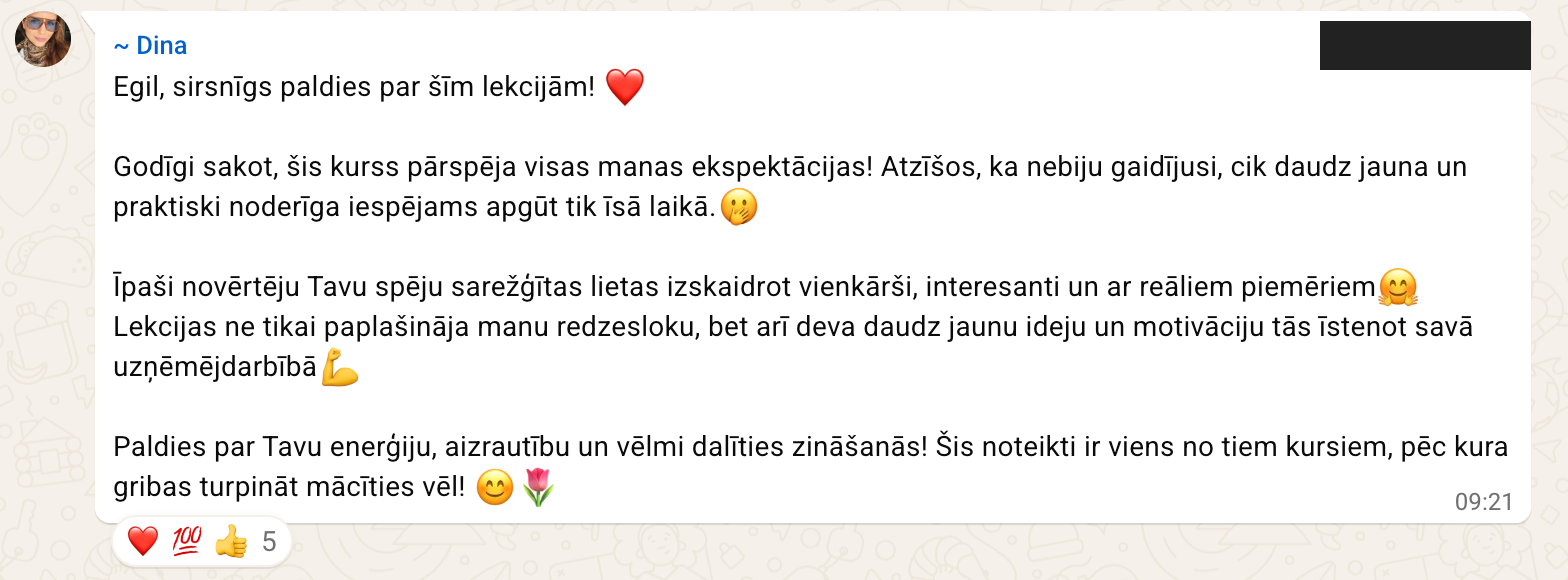
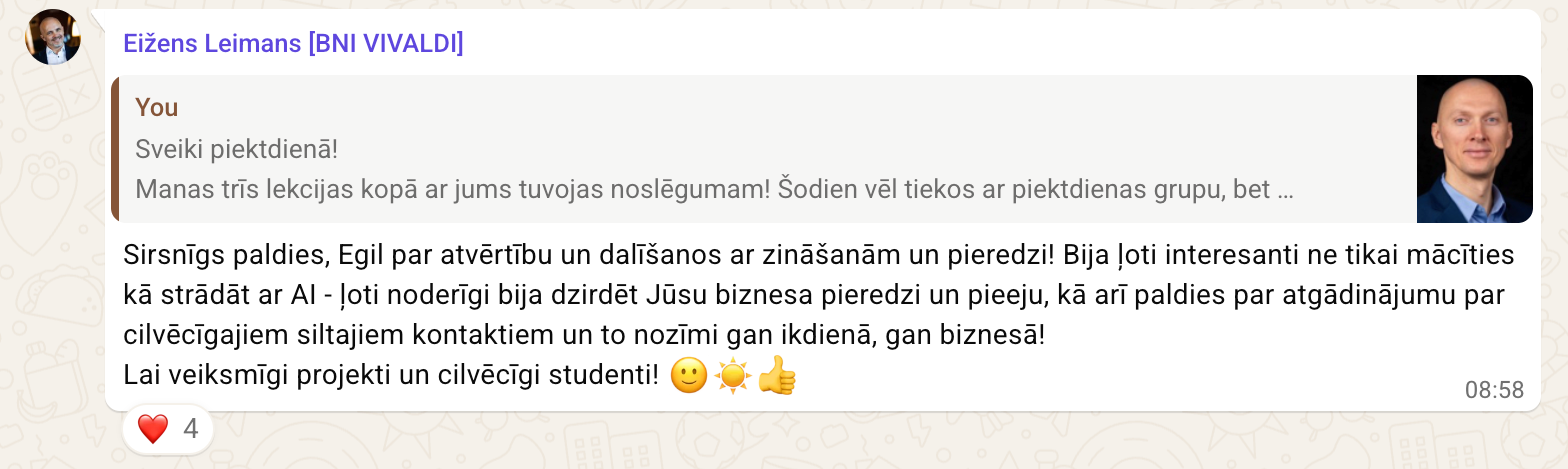
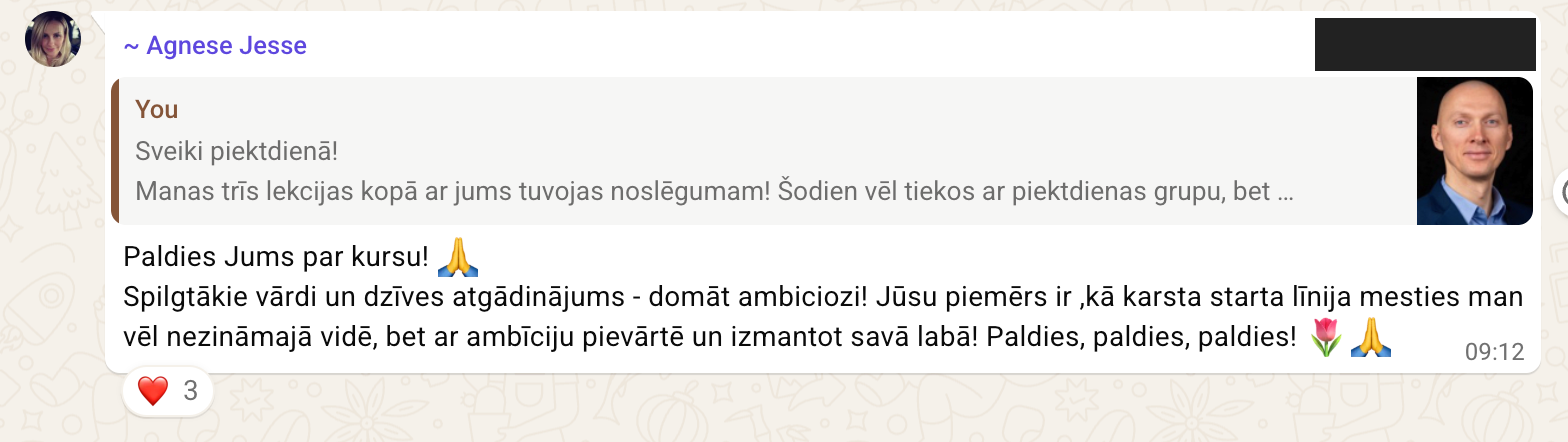



*Translated from Latvian. The screenshots show the original messages.
These messages also remind me of the teacher's job. Inspiration helps people start. To keep going, they need a clear next step and the chance to learn at their own pace.
In class, people asked questions, made choices, challenged results and improved them. That human part remains important as the tools become more capable.
What to take into your own business
I see several valuable beginnings in this experience: clearer priorities, useful drafts and attempts to make recurring work easier. A business brain becomes meaningful when it helps with a task that matters to the owner.
The quality of a first result can vary. Sometimes the context needs clarifying; sometimes a design needs editing or the data needs checking. Value emerges when people can continue the work and understand which parts of the result to use.
To explore this approach for your own company, see the Arete AIOS business-brain guide.
Frequently asked questions
What is a business brain?
Organised company information and working context that help AI work with the specific business's situation.
Was this a standalone Arete AIOS course?
The classes were part of the University of Latvia/LUMA digital marketing programme, developed in collaboration with miniAkselerators. I used the Arete AIOS approach in my teaching.
What do the percentages show?
Answers to separate classroom questions and surveys. They describe participants' reported access, progress, goals and use; they do not establish business outcomes for everyone on the course.
About the figures: each table or chart has its own response base. These are separate classroom and survey samples, not a before-and-after measurement of the same people. Participants' self-assessments are not independently measured revenue, export or time-saving outcomes.